
At Raymatix, we frequently get asked one major question: If Smart TVs block third-party USB cameras, how exactly are you getting 60 frames-per-second motion tracking to work on screens like Samsung, LG, and Hisense?
The answer lies in completely rethinking how hardware communicates. We realized that trying to force heavy video files through restricted USB ports was a dead end. To achieve true, frictionless 3D tracking, we had to stop acting like a traditional webcam and start acting like an independent network computer.
Here is a behind-the-scenes look at the technical magic that takes your physical movements and streams them instantly to your living room screen.
-
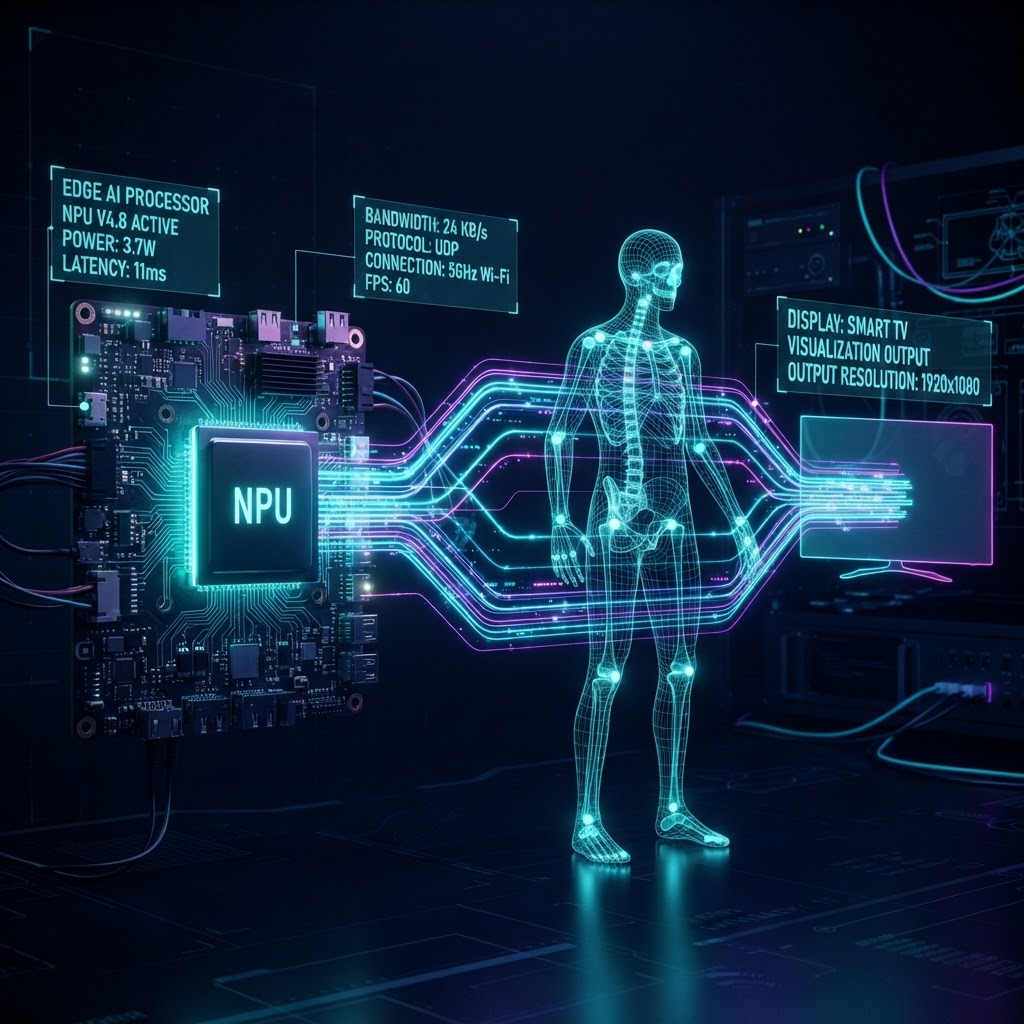
Bypassing the USB Sandbox Modern Smart TV operating systems are highly restrictive sandboxes designed to block custom kernel-level USB drivers. Raymatix bypasses this limitation entirely by functioning as a driverless local network IP node. Instead of plugging into your TV to borrow its computing power, our device connects to your local Wi-Fi network and talks directly to the game application.
-
The On-Board "Brain" If the TV isn't processing the video, what is? The Raymatix sensor is powered by its own built-in Edge AI processor, featuring a dedicated multi-core Neural Processing Unit (NPU). This edge-AI powerhouse processes the high-speed stereoscopic video entirely on board. It instantly maps your physical movements and extracts an industry-standard 17-point human joint matrix (COCO) in real time.
-
The 24 KB/s Compression Miracle By the time the data leaves our sensor, the heavy video files have been completely discarded. We collapse your complex 3D skeletal movements into an ultra-lightweight 24 KB/s binary coordinate stream. Because this file size is microscopic, it requires virtually zero bandwidth to transmit, ensuring your gameplay never lags or stutters.
-
Riding the 5GHz Wave Once the skeleton data is compressed, the system uses low-level network programming (like Boost.Asio) to package these 3D millimeter coordinates into raw UDP packets or WebSockets. The sensor then blasts this lightweight data stream over your local 5GHz Wi-Fi network directly to the Smart TV or console.
-
Bringing the Avatar to Life The final step happens inside the game itself. The game application (built in Unity or Unreal Engine) simply "listens" to the local network to catch our UDP packets. Utilizing middleware like the Raymatix SDK, the game engine instantly translates those raw 3D math numbers into natural character animation. Raymatix applies human anatomical constraints — ensuring your digital avatar doesn't bend its limbs backward — and uses Inverse Kinematics (IK) to map your movements perfectly onto the screen.
The Result: Pure Freedom Because this entire pipeline relies on standard Wi-Fi network sockets rather than proprietary cables or USB drivers, the Raymatix sensor achieves Universal Hardware Agnosticism. It delivers zero-latency, 60 FPS tracking universally across Smart TVs, Next-Gen Consoles (like PS5 and Xbox), and PC VR platforms.
We handle the complex spatial math on the edge, so you can just launch your game, step back, and move.