
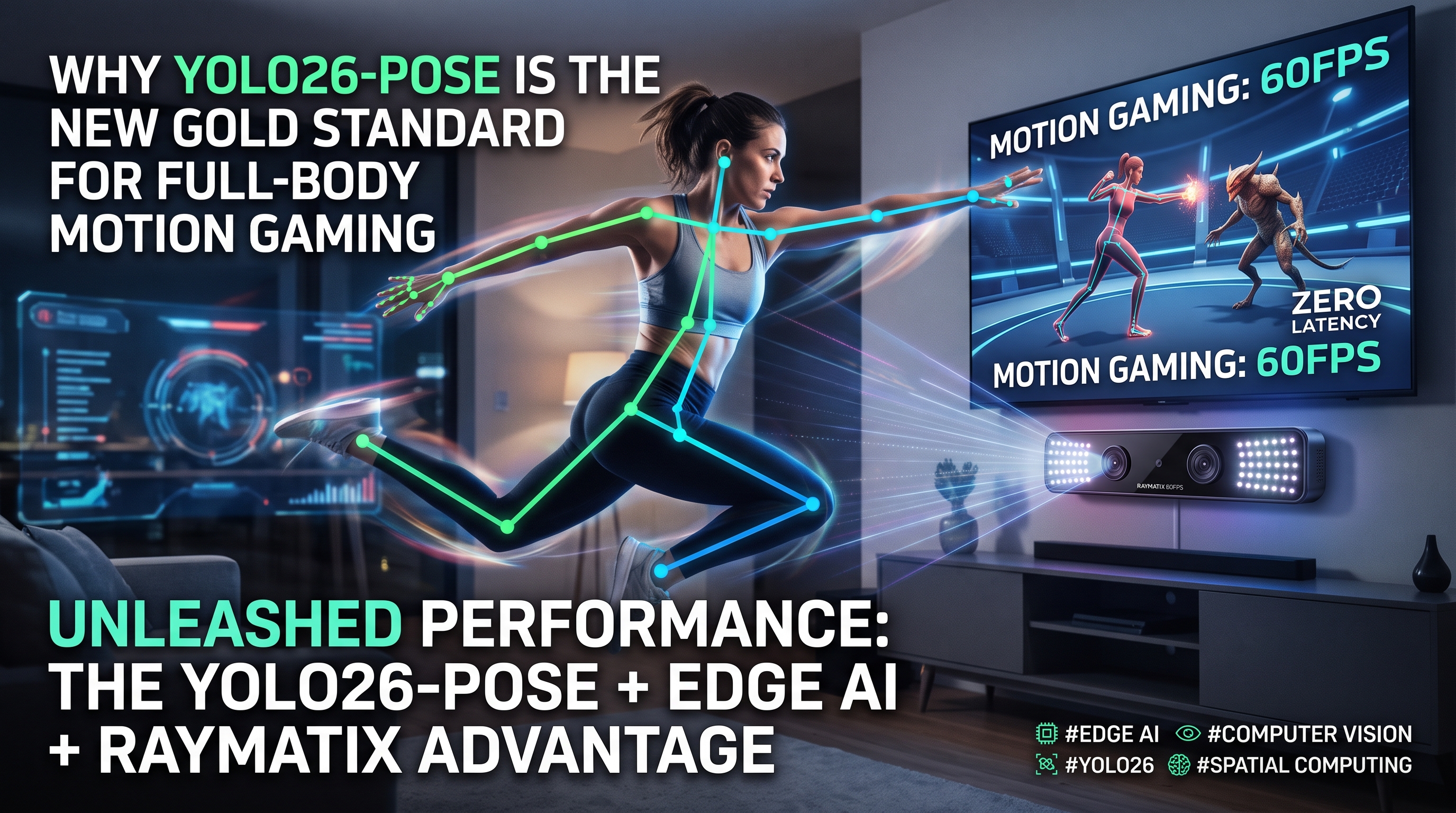
For over a decade, full-body motion gaming has been haunted by the same two ghosts: input you can feel lag behind you, and limbs that jitter the moment you move fast. Swing a virtual racket, drop into a deep lunge, or chain together a dance combo, and the illusion collapses the instant a frame stutters or an ankle drifts off its joint. Players do not notice good tracking. They only notice when it breaks.
The bottleneck was never the idea. It was the math. Older pose models were designed for accuracy on a server, not determinism on a device. That is what makes the combination of Ultralytics YOLO26-Pose, on-device Edge AI, and a 60 FPS spatial sensor like the Raymatix 3D motion sensor genuinely different: it removes the compromises rather than working around them.
The 16.6-millisecond ceiling
A stable 60 FPS game loop is not a target. It is a contract. Every stage of the pipeline — frame capture, inference, joint solve, render — has to complete inside a single 16.6 ms window, every frame, with no surprises. The moment any stage runs variable-time, the loop loses its determinism and the player feels it as a hitch.
Legacy computer-vision architectures were never built for that contract. Three habits kept them off the edge:
- CPU-bound Non-Maximum Suppression. NMS is a sorting problem, and sorting time grows with the scene. Add a second player or a fast-moving limb and the post-processing step suddenly eats a variable slice of the frame budget, producing the exact micro-stutters motion games cannot tolerate.
- Distribution Focal Loss overhead. DFL improved accuracy on benchmarks, but its non-linear regression heads are expensive to quantize and awkward for NPUs. On edge hardware they either fall back to slow paths or refuse to compile at all.
- Cloud round-trips. Streaming frames to a server for inference adds tens to hundreds of milliseconds of network jitter before a single joint is drawn. It also sends raw video of your living room off-device — a non-starter for a consumer product.
Why YOLO26-Pose changes the equation
YOLO26 is the first pose architecture that reads like it was designed by people who had to ship it on a $99 box. The headline changes all push toward deterministic edge inference:
- Native end-to-end, NMS-free inference. The post-processing sort is gone. Frame time stops scaling with scene complexity, so a crowded room and an empty room finish in the same budget — exactly what a game loop needs to stay in sync.
- A DFL-free, NPU-friendly head. Removing Distribution Focal Loss means the model exports cleanly to INT8 and FP16 across RKNN, TensorRT, and CoreML without unsupported-operator fallbacks. What compiles is what runs.
- Uncertainty-aware RLE keypoint regression. Instead of smoothing jitter away with heavy temporal filtering (which adds latency), YOLO26 encodes uncertainty directly into the keypoint regression. Wrists, elbows, and ankles stay locked to the joint even at speed, without the soft, trailing feel of a low-pass filter.
- Sub-2 ms inference on lightweight variants.
yolo26n-poseleaves so much headroom on the NPU that game physics and rendering get the compute back that inference used to steal.
The result is a model that does not just score well — it behaves well. Deterministic, portable, and fast enough that inference stops being the long pole in the tent.
60 FPS tracking needs 60 FPS eyes
A fast model is wasted on a slow sensor. Most consumer webcams sample at 30 FPS with rolling shutters that smear any quick motion into a blur the model has to guess through. Pairing YOLO26-Pose with a high-speed spatial sensor like Raymatix closes that gap and turns the pipeline into a proper end-to-end gaming node:
- Synchronized 60 FPS ingestion captures rapid motion cleanly, so the model sees real edges instead of motion-blurred ones.
- Dual-camera active IR makes skeleton extraction a function of geometry, not lighting — it works in a pitch-black living room or under a glare of afternoon sun.
- True 3D spatial geometry gives you real depth on every joint, enabling 17-point kinematic tracking that understands room-scale play rather than inferring it from a flat image.
The sensor does the part the model cannot: it gives YOLO26 clean, high-frequency, three-dimensional input. Everything downstream gets easier.
The edge advantage: privacy, performance, and no cloud
Running this pipeline on-device — on an edge NPU or a local SoC — is what makes the whole thing shippable. Video never leaves the room, so privacy is architectural rather than a policy. The data path is sub-millisecond, so responsiveness is physical rather than aspirational. And because there is no server in the loop, the architecture scales by adding players, not infrastructure.
Sluggish, clunky gesture control was not a genre limitation. It was a pipeline limitation. With YOLO26-Pose, Edge AI, and high-speed sensors like Raymatix, the pipeline finally fits the experience — and responsive, living-room spatial gaming stops being a demo and starts being a product.